
2020
Estatik — real estate plugin
A complete design solution for Estatik: creating a powerful WordPress plugin with modern UI, user-friendly templates, and a sales website that drives conversions.
Estatik helps customers build full-featured real estate websites. It is a professional tool for projects of any scale, from a small single-agent website to a large real estate portal.

As a French web agency, I chose the Estatik plugin for a real estate website we developed for one of our clients. I'm very happy with this choice — the plugin offers a wide range of useful features and is easy to integrate.
by Iryna GIBERT, Jun 9, 2025
I have been using the Estatik Pro plugin for a real estate website and I am very happy with it. It is a versatile and reliable plugin. It has a lot of features that make my website stand out.
by Team DMY, Aug 7, 2023

Estatik handles listings beautifully, is very customizable, and is built with SEO/SEM in mind. Their support team is second to none and responds to inquiries quickly and accurately. The only plugin a realtor should use to promote listings online.
by phenn, Mar 8, 2025
I was responsible for the product experience strategy and the full design of the plugin:
• User and market research
• Workflow analysis and UX architecture
• Wireframing and prototyping
• Interaction and visual design
• UX writing
• Building a design system
My role and the challenge
The goal was to enhance Estatik functionality and usability beyond competitors and create a better experience for all types of customers.
Research
We conducted market analysis and interviews with customers and users to identify the main pain points.
Key insights included complex navigation, overloaded property submission forms, and non-intuitive template settings.
These insights shaped the product architecture and guided the feature design.
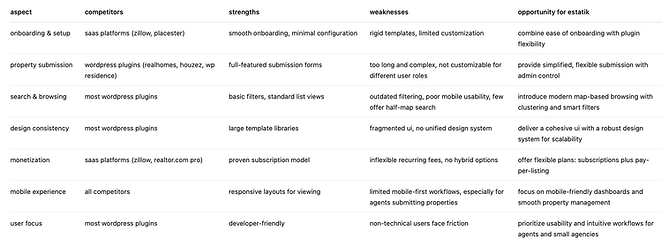
Some concrete findings included
🚩 Registration and login processes were cumbersome, with many users abandoning signup.
🚩 Navigation between property lists, templates, and settings was confusing, leading to frequent errors.
🚩 Inconsistent labeling and unclear icons in property cards led to misinterpretation of key information.
🚩 Users struggled with long submission forms containing unnecessary fields, causing incomplete listings.
🚩 Visitors had difficulty filtering properties by multiple criteria at once.
Design approach

For complex workflows, I created wireframes and flowcharts to align the team early and validate user flows.
-
91 wireframes.
-
Interactive prototypes for usability testing.
-
Detailed design specifications for developers, including component behavior, responsive rules, and interaction details.
-
A design system based on atomic design principles, ensuring consistent interfaces and speeding up future development.

UI kit
Based on atomic design principles, ensuring consistent interfaces and speeding up future development.





Key solutions
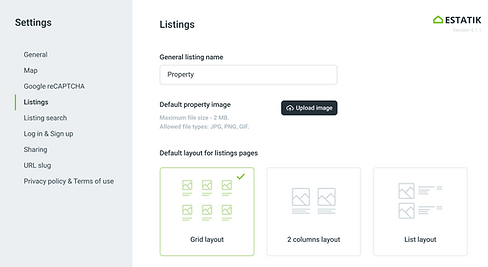
Property list pages
Flexible property listing pages that allow site owners to customize the display, while visitors can easily browse and find properties.


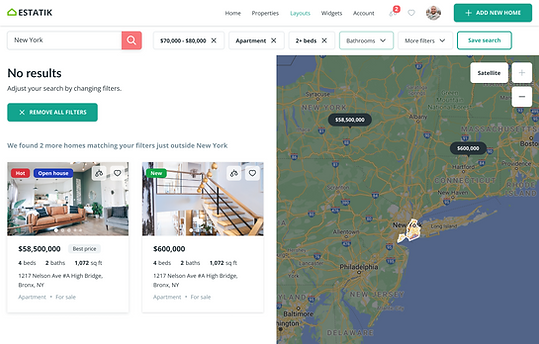
Half map page
-
Marker clustering for properties located in the same area.
-
Custom map pins and markers cluster.
-
Unique markers for different property categories or types.



-
Clickable regions and provinces.
-
Displaying relevant results outside
the current search area.
-
User-friendly pop-up with essential property details.
Property cards
-
Two layout options for property cards.
-
Customizable labels and price badges.
-
Adding to favorites or comparison list.
-
Price change indicators.
-
Icon sets for property features.
-
Option to display title instead of price.
-
Displaying agency information.


Property publishing
-
Intuitive dashboard for adding properties without dealing with WordPress pages or clunky forms.
-
Admin controls which fields are shown or required.
-
Simplified submission process for contributors.

Subscription and paid listings
-
Flexible membership packages with custom duration, number of listings, and featured slots.
-
An alternative one-time payment option for publishing individual listings and promoting them as featured.
-
Visibility control for packages without affecting existing subscribers.


Property page templates
-
Different listing page templates to fit various business needs.
-
Visually clean layouts focusing on images and key property details.


Impact & advantages
Better user experience drives business growth
-
Simplified property publishing and searching
-
Reduced errors during submission
-
Improved experience for both administrators and end users
-
The unified design system reduced development time and improved consistency for future features